Published on :
Announcements
Harmony
Retail rollouts do not fail because teams cannot plan.
They fail in the space between the plan and the field.
When a program spans hundreds of technicians and thousands of store locations, the work stops being “project management” in the classic sense. It becomes a daily fight against fragmentation: updates scattered across email threads, spreadsheets, tickets, and vendor portals. Exceptions show up late. Visibility arrives after the window closes. And the people responsible for delivery end up spending most of their time chasing status instead of driving execution.
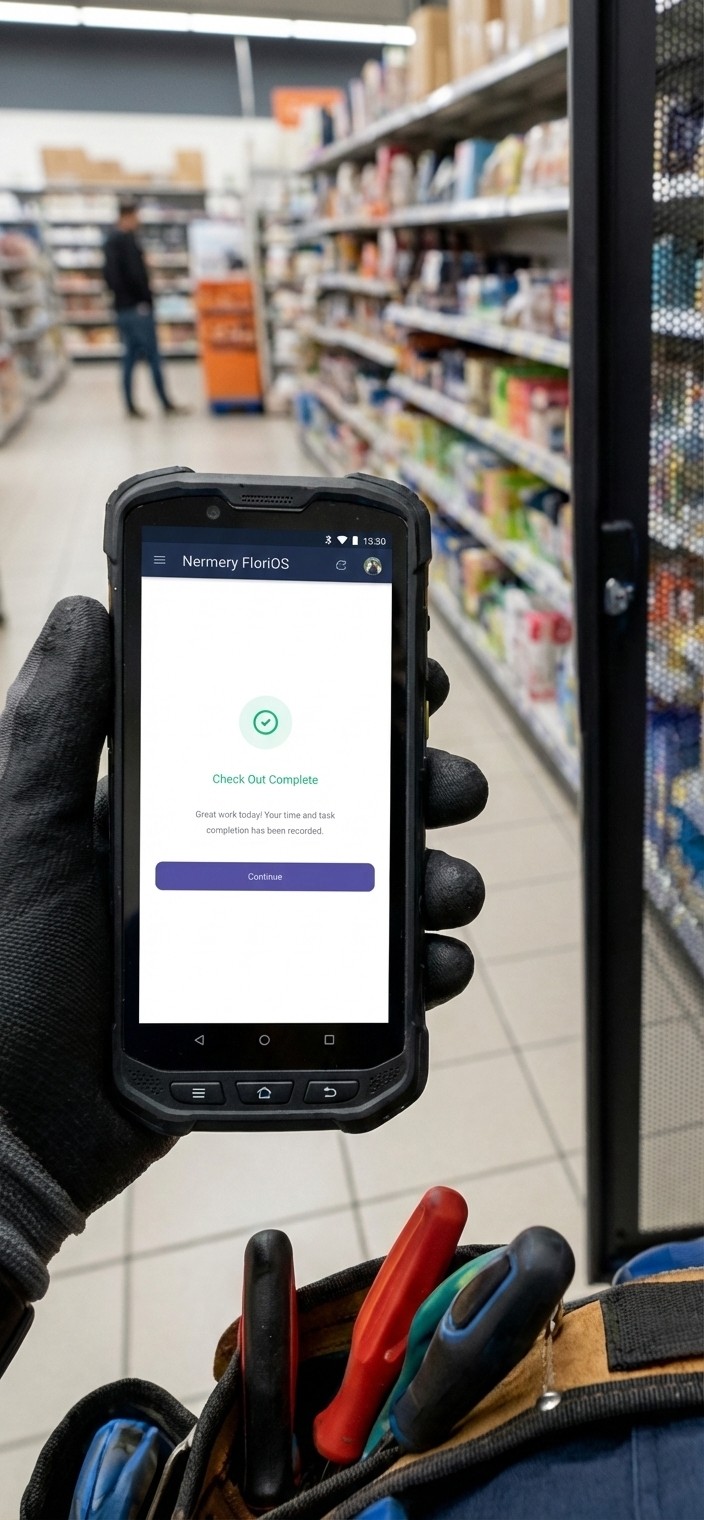
Today we are announcing Harmony FieldOS, a new execution capability for Harmony, Coworked’s AI Project Manager coworker.
FieldOS is our first specialized execution module, built specifically for large-scale retail technology rollouts and deployments.
Why we built FieldOS
If you lead store rollouts, you already know the pattern:
A rollout is “green” until it is suddenly not
A small exception at a single site can cascade into a regional delay
Technician capacity is not the constraint, coordination is
Every stakeholder wants one answer: “Are we on track, and what is at risk?”
The bigger the program, the more the work shifts from managing tasks to managing exceptions, handoffs, and truth.
And truth is hard to maintain when progress is reported manually.
FieldOS was built to close that gap. Not by introducing another dashboard, but by giving Harmony a reliable way to run the execution loop that great rollout leaders run every day.
Coworked, Harmony, and FieldOS: the hierarchy matters
Let’s make the structure clear.
Coworked is the company.
Harmony is Coworked’s AI Project Manager coworker.
Harmony FieldOS is a new execution capability for Harmony, built for retail field deployment at scale.
FieldOS is not a separate product line. It is how Harmony moves from coordination into specialized execution, starting with retail.
What FieldOS changes
Most rollout operations have the same hidden bottleneck: the work required to keep execution coherent.
That work looks like:
Confirming site readiness
Reconciling conflicting updates
Getting the right person on the phone at the right time
Escalating issues before they become delays
Translating field activity into stakeholder-ready reporting
It is relentless, and it is mostly invisible until it fails.
FieldOS is designed so Harmony can take on that coordination burden, continuously, across every site.
The FieldOS execution loop
FieldOS follows a simple, repeatable flow:
Plan
Harmony ingests the rollout plan, the locations, and the constraints.
Dispatch
Harmony coordinates assignments and timing across technicians, partners, and sites.
Verify
Harmony captures completion signals and required proof of work.
Escalate
Harmony surfaces exceptions early and routes them to the right owner, fast.
Report
Harmony produces a clean, location-level and program-level view of progress, risks, and next actions.
This is not theoretical. It is the operating rhythm rollout leaders already run, now executed with consistency at scale.
Built for retail technology rollouts
FieldOS is designed for the store estate reality, including programs like:
POS refreshes and peripheral swaps across hundreds or thousands of stores
Store network upgrades: switches, access points, cabling, back office infrastructure
Self-checkout expansions and kiosk deployments
Digital signage and in-store device refresh programs
Remodel cutovers where timing, sequencing, and readiness decide success
These programs share the same truth: success depends less on planning tools and more on execution coherence.
For retail services providers: delivery advantage, not overhead
Retail services providers live in the hardest part of the rollout: execution across multiple parties, multiple systems, and a constant stream of exceptions.
FieldOS is built to support that reality:
Coordinating internal teams and subcontractors
Managing site readiness and access constraints
Capturing proof of work and consistent closeout
Producing retailer-ready status that does not require heroics
The result is not more process. It is less chasing, fewer surprises, and clearer outcomes.
Why this is “specialized execution,” not “more automation”
There is a lot of noise in the market about agents and copilots. Most of it is oriented around making tools easier to use or generating better suggestions.
FieldOS is different. It is part of a deliberate product direction: Harmony is moving from generic administrative coordination into specialized execution, delivered as modular capabilities built for real operating environments.
Retail rollout execution is our first focus because it is a domain where:
the scale is real
the cost of delay is real
the exception rate is real
and the coordination burden is enormous
FieldOS is the first module in that path.
Availability
Harmony FieldOS is launching through a controlled initial rollout with select retail and retail services organizations. We are working closely with partners to support production-grade deployments and establish repeatable execution patterns.
If you lead retail rollouts, store technology deployments, or manage large-scale execution for retailers, we would like to talk.
See FieldOS
We will share more at NRF 2026, with the launch announcement on January 12, 2026.
To learn more or request a walkthrough, visit coworked.ai/harmony-fieldos.
A final note
Rollouts are where strategy meets reality.
FieldOS is built for that moment.
Not to add another system to manage, but to put execution back under control, site by site, exception by exception, until the rollout is done.
If this is your world, keep January 12 on your radar.
Coworked